Housed and Homeless
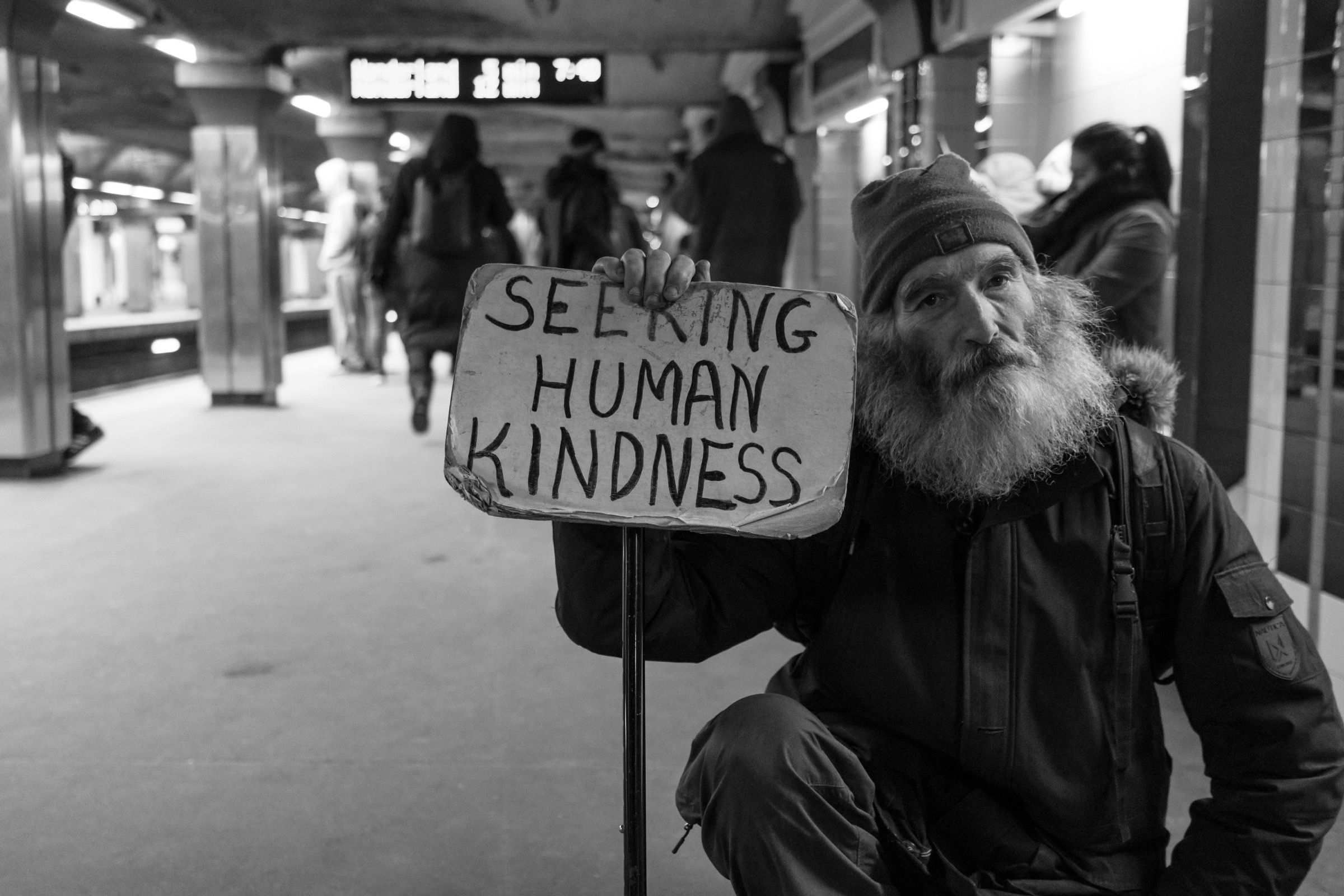
Most Canadians, when they think about homelessness, often think about what you’d see if you walked along 105a Avenue in downtown Edmonton, along a path that would lead you past two of our downtown shelters. Misaligned groups of people huddled together talking about their community news of the day. Some sitting on the sidewalk using the brick exterior of a building to keep them upright. Some smoking. Often someone will have a speaker playing music. Our Community Members have great taste in music. Some are in the middle of a high, some are on their way up and some are falling back down. The landing leaves many in need of help from our paramedics on call.
This is not homelessness. At least not typical homelessness. Typical homelessness is the many who come through our doors who have experienced a crisis which has led to the loss of their home. Job loss, chronic illness, minor conviction, hospitalization; leading to eviction. Leading to needing emergency shelter. The barriers to being housed again are low, and with the connection to the right service or support they will quickly find themselves housed again. That story is the norm, and one that doesn’t get told very often.
We’re simply not going to move the needle very far without a fundamental shift in the way we understand homelessness. Simply because, at the end of the day, ‘homeless’ is a catch-all label we slap on those in our community who do not have the necessary skills, abilities and privileges required to succeed in a society governed by a system built by those who do. Vilifying those who do not or cannot thrive in that system is nothing but social Darwinism.
Poverty comes in many forms: material poverty (the lack of material resources), relational poverty (the lack of key relationships), spiritual poverty (the lack of spiritual connection) and cultural poverty (the lack of connection to one’s culture). All of them are caused by broken relationships. Broken relationships between you and yourself, you and others, you and God or you and the planet. In my experience, many of the Community Members we serve, maybe even most, would be sustainably housed long-term with access to more affordable housing. If material poverty is the only reason someone is unhoused, then quick, efficient financial relief can make a world of difference. But what about those whose experience with homelessness is caused by other forms of poverty? What if there is more that’s broken than just economics? Can you be housed and still homeless?
For many of our homeless population in downtown Edmonton, homelessness is a symptom of a brokenness that began years before coming to the front door of a shelter. Brokenness rooted in trauma.
A US study from 1997 found that lack of parental care increased the odds of someone becoming homeless by 13 times. That same study found that physical abuse in childhood increased someone’s odds of becoming homeless by 16 times. When both were true, the odds of experiencing homelessness in adulthood increased by 26 times.1
Source: Herman et al., Adverse childhood experiences: Are they risk factors for adult homelessness?, American Journal of Public Health, 1997.
Growing up in Saskatchewan I had a mix of experiences with the local Indigenous population. By the mid-1990s Canada was turning a corner. The last residential school was closing, which was only the beginning of coming to understand what that meant and what happened there. The author of the 1969 White Paper, Jean Chrétien, was Prime Minister. A regrettable piece of our history. I have fond memories of going on school field trips to Wanuskewin near Saskatoon, and researching different tribes in school. I also remember some of the horrible things that family members would say about First Nations peoples, mocking the way they spoke. I remember being made to feel afraid when we’d need to stop for gas in a First Nation when we went fishing up north. The irony is no longer lost on me.
I didn’t realize when I started working with people experiencing homelessness that this work would push me as hard as it has to understand Indigenous culture and history, and to grapple with the realities of truth and reconciliation. In my ignorance I didn’t see the connection. I knew that a disproportionate number of our Community Members were Indigenous. I didn’t realize to what degree. Whereas Indigenous peoples account for ~6% of Edmonton’s population,2 our own shelter data shows they make up 60% of the people seeking shelter with us on any given night.3 That’s not a coincidence. And the answer to the problem is not simply more affordable housing. That will help. But there is a brokenness that goes deeper than not being able to afford rent. There is a pain that needs healing. There is a trauma that needs justice; a trauma that I have played a role in causing.
Source: Hope Mission shelter data, January–October 2026; Statistics Canada, 2021 Census.
Ending homelessness, as virtuous as that goal is, is not going to happen without an Indigenous-focused, trauma-informed approach. No matter how much money governments spend, homelessness in this country will only come to an end when the generations of people broken by the residential school system find healing and wholeness. When I can freely offer my privilege through support, advocacy and removing barriers, so that Indigenous-led initiatives can have the freedom to exist unhindered. Indigenous communities have built systems for self-healing and trauma response that are far better than anything non-Indigenous peoples have. We need to enable and empower Indigenous communities to function as they were intended and then get out of the way.
Hollow Water First Nation, an Anishinaabe community on the east shore of Lake Winnipeg, is one example. In 1985 the community began building its own response to sexual abuse among its people, abuse with roots in the residential school era. They called it Community Holistic Circle Healing. Instead of handing it over to the courts, the community brought the legal system into its own healing circles, working with victims, offenders and their families together. A federal study found the community ran it for about $2.4 million over its first ten years, compared with an estimated $6 to $15 million for comparable government services, and called it the most mature healing process in Canada.4 Over those ten years, 107 offenders went through the process and only 2 reoffended. That’s about 2%, compared with about 13% for sex offences in the wider justice system.5
Source: Buller, Aboriginal Community Healing Processes in Canada, 2005.
As much focus and attention is placed on housing initiatives, the same needs to be placed on child welfare systems. The Midwest Study, a US study run by Chapin Hall at the University of Chicago, followed 730 youth from foster care into adulthood between 2002 and 2011. 1 in 3 of those youth experienced at least one episode of homelessness by age 26.6 Here in Canada, a 2026 study of British Columbia youth found that child welfare involvement was the strongest childhood predictor of youth homelessness, and the longer a child was involved, the higher the risk: 11% of children with one year of child welfare involvement became homeless between the ages of 19 and 27, compared with 16% of those with four to six years.7
Source: Russell, Hilario and Carr, BC Youth Homelessness Prevention Project, PolicyWise for Children and Families, 2026.
If we’re going to invest $30 billion to create the conditions to end homelessness in the next ten years,8 we will utterly fail if we think the only thing we need is more affordable housing, and if we aren’t willing to address the underlying causes of the types of poverty that result in what we see in front of our shelters. Trauma leads to brokenness. Brokenness leads to poverty. Poverty leads to homelessness.
Sources
-
Herman, D. B., Susser, E. S., Struening, E. L., & Link, B. L. (1997). Adverse childhood experiences: Are they risk factors for adult homelessness? American Journal of Public Health, 87(2), 249–255. https://pmc.ncbi.nlm.nih.gov/articles/PMC1380802 ↩
-
Statistics Canada (2022). Focus on Geography Series, 2021 Census of Population: Edmonton (Census metropolitan area), Indigenous peoples. The Edmonton census metropolitan area had about 87,600 Indigenous residents, 6.3% of its population. https://www12.statcan.gc.ca/census-recensement/2021/as-sa/fogs-spg/page.cfm?lang=E&topic=8&dguid=2021S0503835 ↩
-
Hope Mission shelter data, January–October 2026. ↩
-
Couture, J., Parker, T., Couture, R., & Laboucane, P. (2001). A Cost-Benefit Analysis of Hollow Water’s Community Holistic Circle Healing Process. Ottawa: Solicitor General Canada. https://www.publicsafety.gc.ca/cnt/rsrcs/pblctns/cst-bnft-hllw-wtr/index-en.aspx ↩
-
Buller, E. (2005). Aboriginal Community Healing Processes in Canada (p. 5). Paper presented at the International Institute for Restorative Practices conference, Manchester, England. https://www.iirp.edu/images/pdf/man05/man05_buller.pdf ↩
-
Dworsky, A., Napolitano, L., & Courtney, M. (2013). Homelessness during the transition from foster care to adulthood. American Journal of Public Health, 103(S2), S318–S323. https://pmc.ncbi.nlm.nih.gov/articles/PMC3969135. The study found that between 31% and 46% had been homeless at least once by age 26. ↩
-
Russell, M., Hilario, C., & Carr, R. (2026). BC Youth Homelessness Prevention Project: Final Report (p. 3). Edmonton: PolicyWise for Children & Families. https://policywise.com/wp-content/uploads/2026/03/BC-Youth-Homelessness-Prevent-Final-Report.pdf ↩
-
Prime Minister of Canada (2026, November 6). “Prime Minister Carney launches plan to put Canada on a path to end homelessness within 10 years in Budget 2026, starting with a landmark partnership in Manitoba.” https://www.pm.gc.ca/en/news/news-releases/2026/11/06/prime-minister-carney-launches-plan-put-canada-path-end-homelessness. Budget 2026 commits “nearly $30 billion” to the plan. ↩
