Three Days, One Van and a Wall of Sticky Notes
This week I spent three days in Victoria with some of my favourite people at Hope Mission, a few hundred sticky notes and one big question: how do we build the kind of community partnerships that get our Rescue Van in British Columbia used every single day?
If you haven’t come across a design sprint before, it’s a process Google Ventures developed for answering big questions by building and testing instead of debating. You map the problem, sketch solutions, pick the strongest, build a realistic prototype and watch real people react to it. We squeezed the usual five days into three. This was the first Design Sprint I’ve ever facilitated so I didn’t sleep much the night before.
The van
Our Rescue Van ministry in BC is just over a year old: a small crew in Victoria and another in the Lower Mainland, offering sandwiches and water, warm clothes, wellness checks and rides to the places where people can get help. In Edmonton the Rescue Van is woven into how the city responds to non-emergency calls, and the phone rings constantly. In BC it rings far less often than it should. Not because the need isn’t there. Because the people who could be calling don’t know what the van does or how to ask for it. This has resulted in our teams taking many calls for support that would not traditionally fit our Rescue Van ministry, including helping someone move and transporting someone to a recovery centre two and a half hours up-Island.
The teams running our Rescue Vans have a huge heart to serve those experiencing homelessness, and some have experienced homelessness and addiction themselves. In Vancouver the problems associated with a large population of people living rough are well established norms. In Victoria they’re new. The rapid growth of the unhoused community in Victoria has created a noticeable us-vs-them mentality as homeowners paying over a million dollars for a basic dwelling struggle to contextualize the person who pitches a tent on their sidewalk just to get out of the rain.
The team
Our BC Director sat in the Decider’s chair. Van crew from both regions made up the rest of the team, and Steph and I facilitated. Phones went into a basket at the door, which is always the first small miracle of a sprint.
I want to say something about this team, because they’re the reason any of this worked. One crew member told us this isn’t a job, it’s a calling. Another starts every shift in prayer at six in the morning. These are people who already give everything to the work, and asking them to spend three days with markers and timers is a big ask. They showed up anyway, and they showed up fully.
One thing the team struggled with was the line between strategy and planning and having faith in God and responding to what God is asking us to do in the moment. At the beginning of the Sprint the most common response to “What will we be doing in 2 years?” was “Whatever God asks us to do.” This is a very common situation (notice I’m avoiding calling it a problem). Especially for a group of people who started this work on a daily grind of prayer and faithful obedience. However as anything grows, a ministry, a company, a person, the rapid-response faith needs to mature into faithful long-term planning and prayer-filled long-term strategizing. God knows what He will be doing in two years. We can ask Him today to give us a glimpse into what He’s planning and the wisdom to build out a strategy that is both aligned to His will and will get us as close as possible to His long term goals.
Day 1: mapping the problem
We started by setting a goal for the next two years. After a lot of honest conversation, the team landed on this: In the next 24 months, we want to develop the organization preparedness, community partnerships and operational programs so that we are ready for God to open doors.
I love that sentence. It’s humble and ambitious at the same time.
Then we did a premortem. We imagined it was November 2028 and we had failed, and asked why. Pride. Not listening. Losing focus on Christ. Growing too fast. Failing to understand the culture of the cities we serve. It’s a sobering exercise, and it gave us our three sprint questions: What systems do we need to stay consistent? How do we stay tuned to the culture and needs of the community? How do we stay focused and centred on Christ?
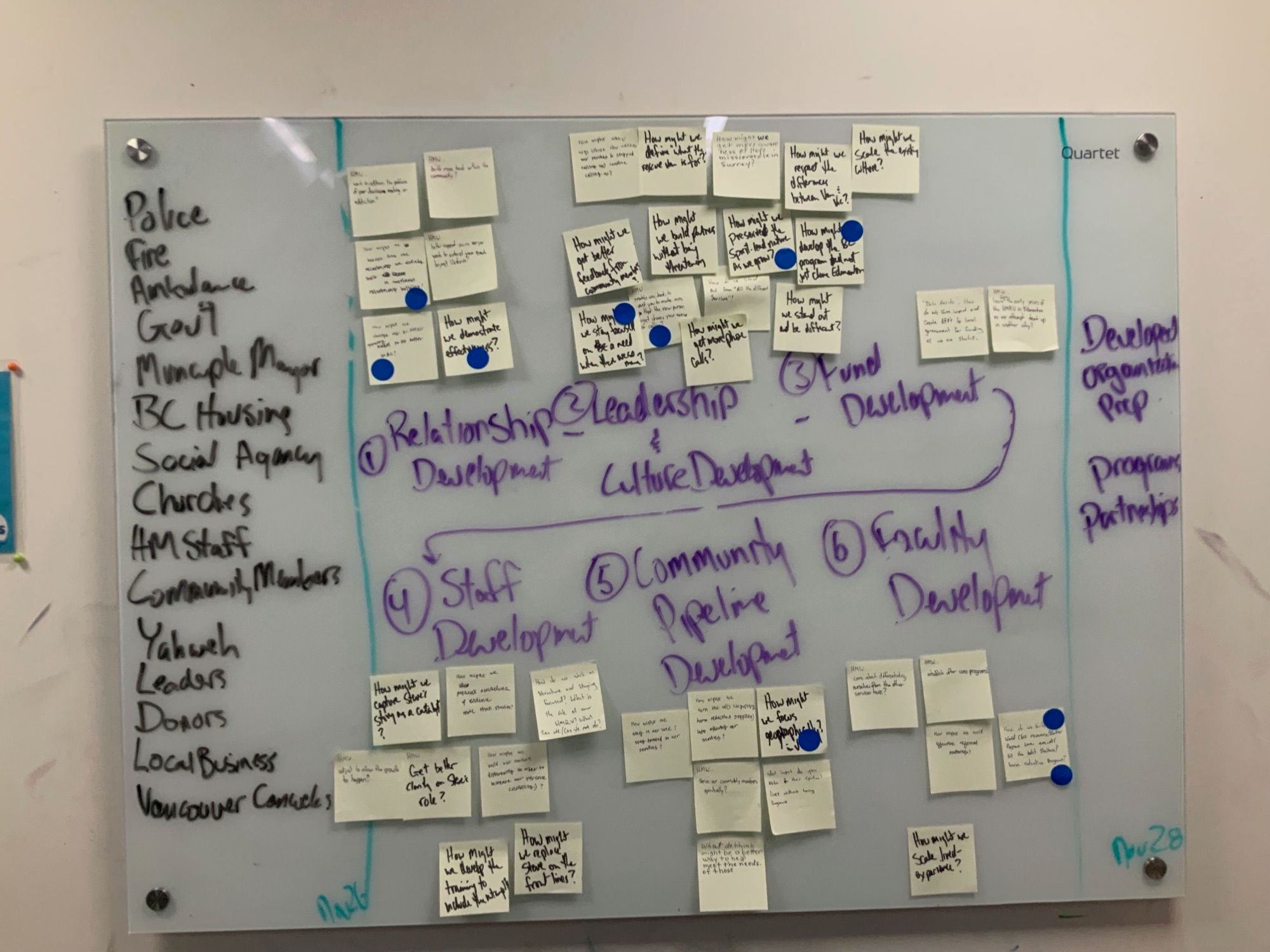
We mapped the journey from where we are to where we want to be, interviewed the team as our experts, and wrote down about 40 “How might we…” questions. Our Decider chose the first step on the map, building relationships, and the question that would steer the rest of the sprint: How might we demonstrate effectiveness? The focus was emergency services, who benefit most when a non-emergency call can go to a van instead of a fire truck or an ambulance.
The part that didn’t work
At the end of Day 1 everyone sketched a solution, and almost nobody sketched a new one. Most sketches were careful drawings of the service as it works today, or of a building we’d love to have someday.
That wasn’t the team’s fault. It was on me. When you live inside a service every day, it’s genuinely hard to imagine it any other way, especially at four in the afternoon.
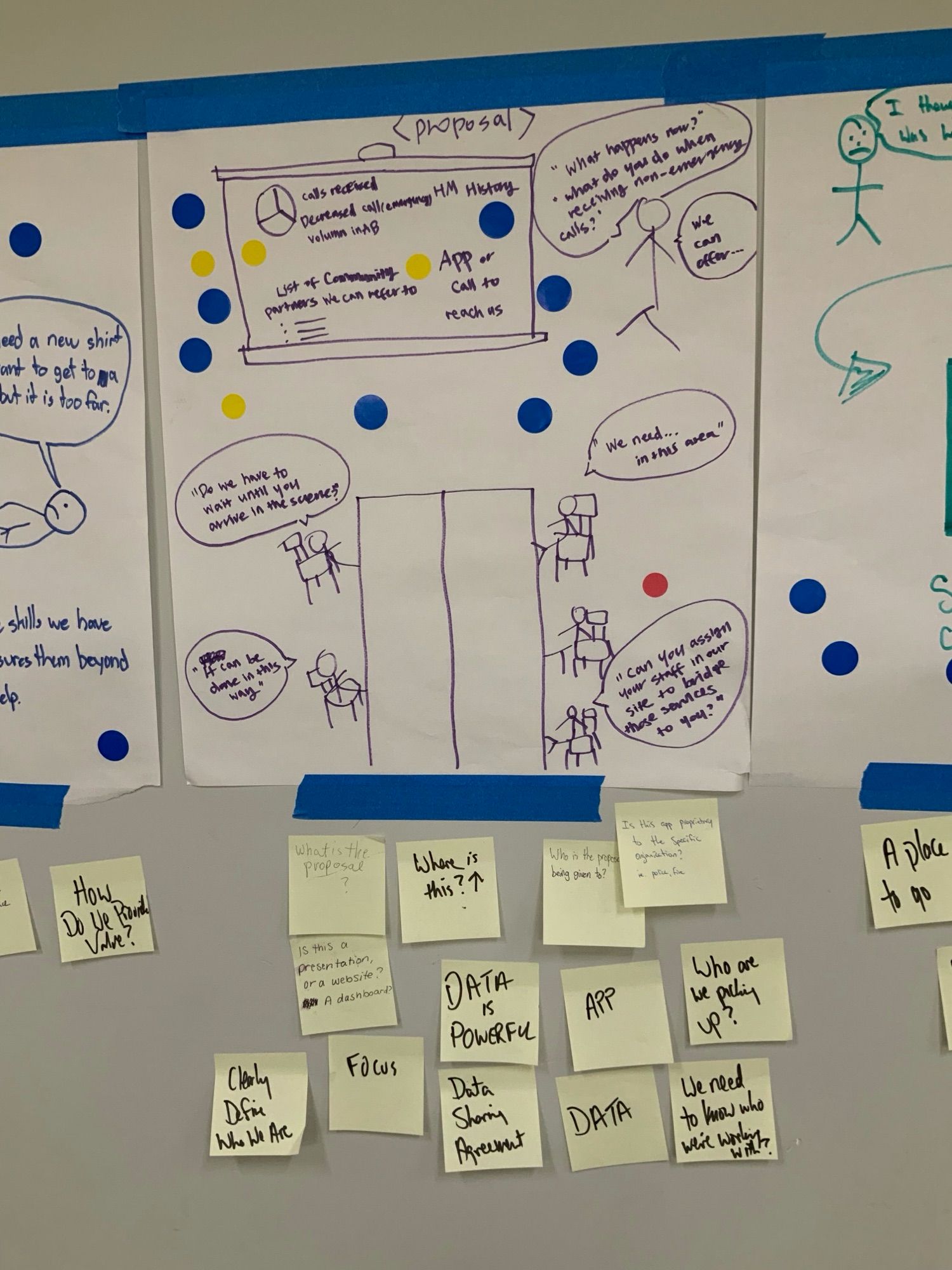
The sketch that won the Decider’s vote was the one that did: a data-backed proposal for partners, with an easy way to request the van and a smooth hand-off from police.
Day 2: building Hope 1-1
We storyboarded the idea frame by frame and then built it. We called it Hope 1-1. It’s a non-emergency dispatch service: an authorized partner signs in, sends the Rescue Van to someone who needs help or a ride to a service provider, watches the van arrive on a live map, and sees reports on every call. The team was clear that it isn’t really an app. It’s a service with a screen in front of it.
By the end of the day we had a working web demo, a partner presentation and a narrated walkthrough video. Real enough to react to, rough enough to finish in a day. That’s exactly what a prototype should be.
Day 3: testing with local organizations
On the last day we put Hope 1-1 in front of four organizations in the Victoria area: a harm reduction society, a municipality, a fire department and a social planning council. Two were local government, and two were community organizations that would be the ones sending the van.
The reactions were better than I’d hoped. “If I was allowed to, I would approve it right now.” “This looks like Uber for service providers.” Every one of them said the need was real.
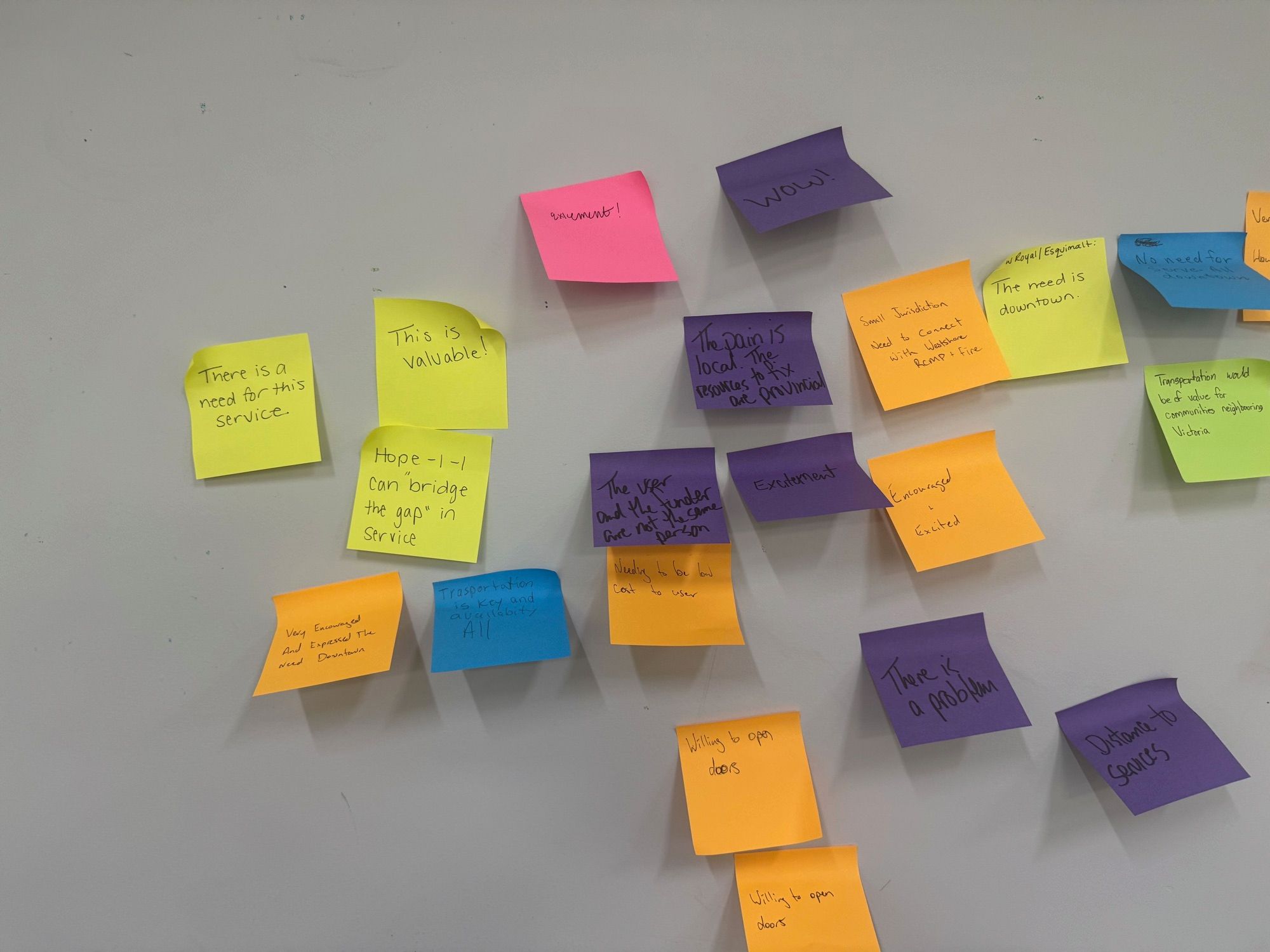
And then they taught us something we couldn’t have learned on our own. None of them could actually buy it. The user and the funder are not the same person. As one note on our wall put it, the pain is local but the resources to fix it are provincial. The real path runs through the people who triage emergency calls across the province: BC Ambulance, police and E-Comm.
We also heard, over and over, that the biggest gap is simply getting people to the services they need. One of them told us fewer than half of the people they help make it to their ID appointments, mostly for lack of a way to get there.
In sprint language, that’s a flawed success. The idea works, and we learned exactly who we need to talk to next. We learned in three days what could easily have taken us a year.
What comes next
Before we left, our Decider committed to 15 things for the next 30 to 60 days. Finish building Hope 1-1. Build a data dashboard. Write down exactly what the van does and doesn’t do. Hire the people the team needs. Connect with the leaders who run emergency dispatch. Get a grant to fund it all. And, my favourite, establish a regular prayer time for our BC staff.
I came home tired and grateful. Grateful for a process that gives every voice equal weight, and for a Decider willing to hear hard things and still make the call. Mostly grateful for a team that loves the people they serve so much that they’ll sit in a classroom for three days and trust the process.
The phone isn’t ringing all day yet. But I think we’re a lot closer to the day it does.